XM Pricing: Spreads, Commissions and Fees on Every Account
 Shrikant Shukla
Published
Contents 18
- 01XM pricing at a glance
- 02What is a spread, in simple words?
- 03XM pricing per trade: what one trade actually costs
- 04How to check XM’s live spreads yourself
- 05Which XM account has the best pricing for you?
- 06Swaps: the cost of holding a trade overnight
- 07Other XM pricing: the non-trading fees
- 08Why XM pricing is different in different countries
- 09Trading from India? Read this first
- 10Open an XM account with our partner code
- 11XM pricing FAQs
So you’re looking at XM and wondering about XM pricing: what will it actually cost you? Good question to ask before you deposit.
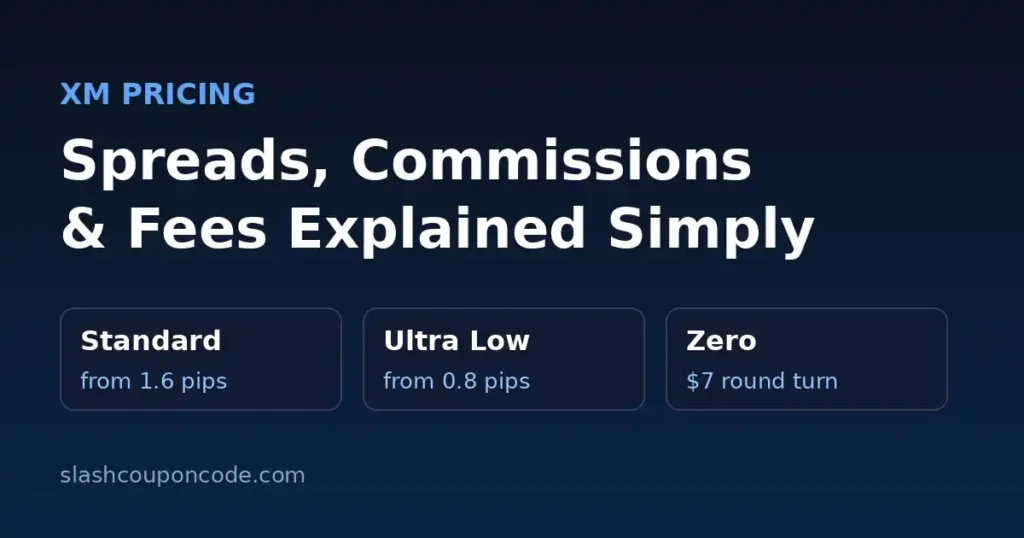
Here’s the deal: XM pricing isn’t a monthly plan or a subscription. You pay in just three ways:
- The spread: a small gap on every trade
- A commission: only on one account type (Zero)
- Swaps: only if you keep a trade open overnight
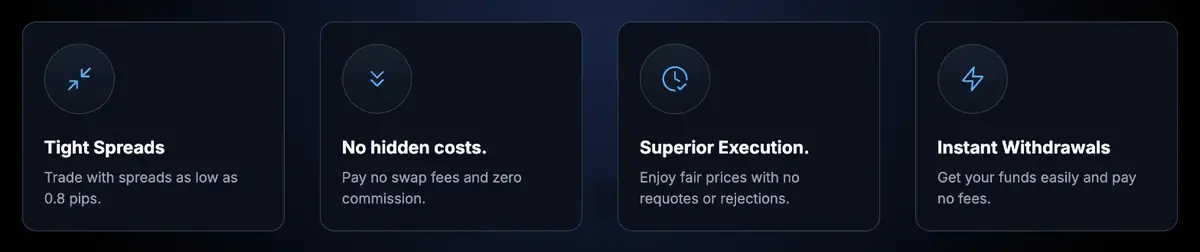
Opening an account is free. Depositing and withdrawing through XM’s main payment methods is free on XM’s side too.
That’s it. Now let’s look at each one, with real numbers so you know what you’re getting into. (Already sure about XM? Grab our XM partner code before you sign up.)
XM pricing at a glance
If you only read one part, read this table. It’s built from XM’s own account types page.
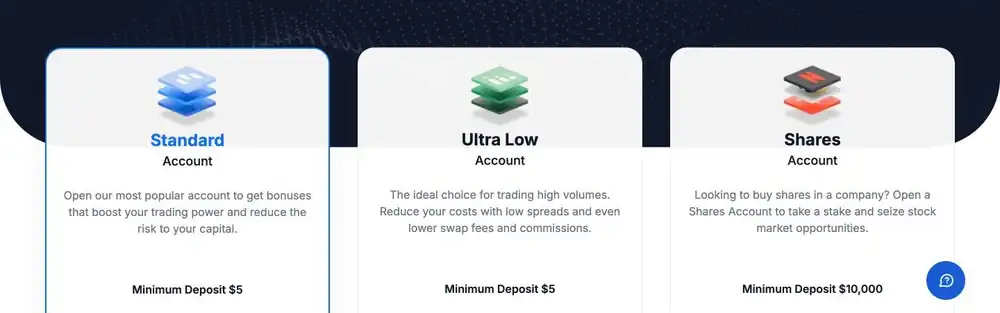
| Standard | Ultra Low | Zero | Shares | |
|---|---|---|---|---|
| Minimum deposit | $5 | $5 | — | $10,000 |
| EUR/USD spread | From ~1.6 pips | As low as 0.8 pips | From 0.0 pips | — |
| Commission | None | None | $3.50 per lot, per side ($7 round turn) | Per-share / percentage |
| Bonuses | Yes | — | — | — |
| Good for | Small accounts, bonus users | Regular traders who want low cost | Scalpers and big-volume traders | Buying real company shares |
Every account also gets negative balance protection (you can’t lose more than you put in), hedging, and an Islamic (swap-free) option.
One thing to keep in mind: these spreads aren’t fixed. The numbers above are the lowest XM publishes. In practice, real spreads get wider around big news, at the daily rollover, and when the market is quiet.
And the Zero account? It’s only offered in some regions. If you don’t see it while signing up, it’s not available in your country.
What is a spread, in simple words?
Think of the money changer at an airport. He buys dollars from you at one rate and sells them at a slightly higher rate. That gap is his profit.
Similarly, a broker’s spread works the same way. There’s a buy price and a sell price, and the small gap between them is what you pay to get in and out of the trade. On XM’s Standard and Ultra Low accounts, that gap is the fee. There’s no separate commission.
XM pricing per trade: what one trade actually costs
Let’s do the maths together. It’s easier than it looks.
Spread cost = spread (in pips) × pip value × number of lots
On EUR/USD, one standard lot (100,000 units) = $10 per pip.
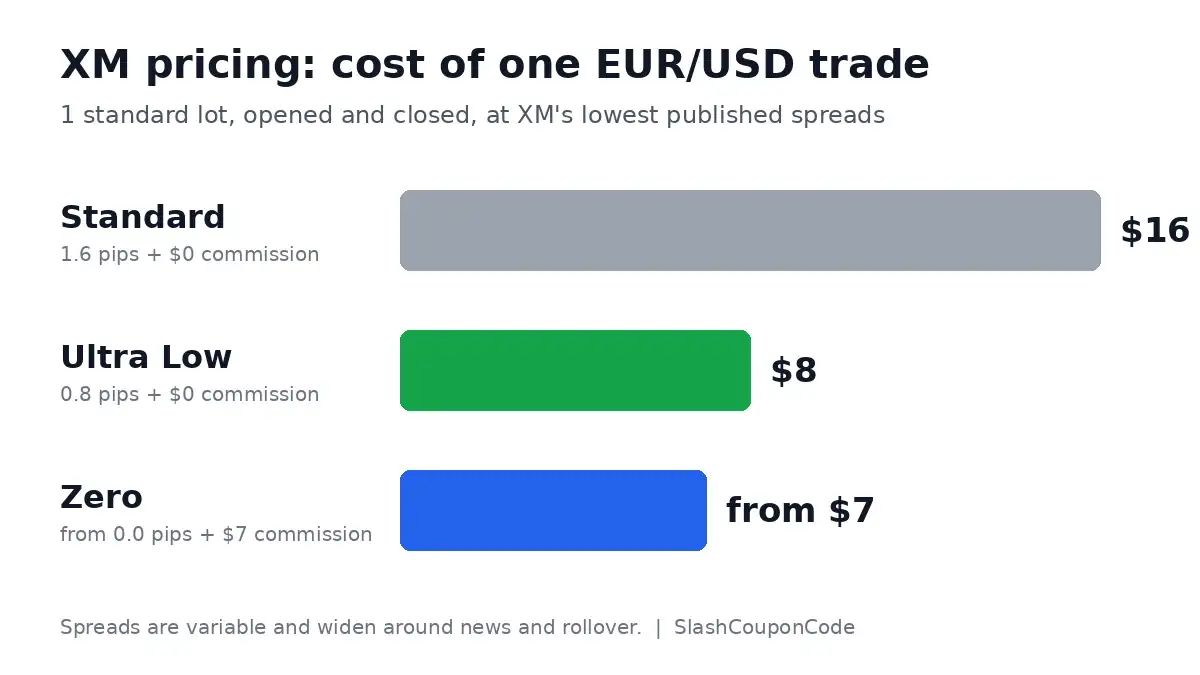
So if you open and close 1 standard lot of EUR/USD at XM’s lowest spreads:
| Account | Spread cost | Commission | Total for the trade |
|---|---|---|---|
| Standard (1.6 pips) | $16 | $0 | $16 |
| Ultra Low (0.8 pips) | $8 | $0 | $8 |
| Zero (from 0.0 pips) | from $0 | $7 | from $7 |
For example, trading small, like 0.01 lots (micro)? Just divide by 100. That’s about $0.16 on Standard, $0.08 on Ultra Low and from $0.07 on Zero.
What this tells you:
- Ultra Low costs about half of Standard on the same trade, and you don’t have to track any commission.
- Zero only saves you a dollar or so per lot over Ultra Low. That’s a lot of money if you trade many lots every day. If you only place a few trades a week, you’ll hardly notice the difference.
However, remember that these are best-case numbers. What you really pay is whatever the spread is at the moment you click buy or sell.
How to check XM’s live spreads yourself
Don’t just trust any article on this, including ours. You can see XM’s exact pricing in under a minute:
- Open MT4 or MT5 and log in to your XM account.
- In the Market Watch window, right-click and turn on the Spread column. You’ll see the live spread in points (10 points = 1 pip).
- Right-click any pair and pick Specification. This shows the contract size, the swap for buying, the swap for selling, and which day gets the triple swap.
Also, a pro tip: check the spread at the time you usually trade. A pair that looks cheap in the busy London session can get noticeably wider near the daily rollover.
Which XM account has the best pricing for you?
Here’s how to think about it, step by step:
- Starting small, or you want XM’s bonus? Go with Standard. The spread is the widest, but it’s the account XM lists bonuses with.
- Trading regularly and don’t care about a bonus? Go with Ultra Low. Same $5 minimum, no commission, and about half the spread of Standard. For most regular traders, this is the cheapest XM account.
- Scalping or trading big volume? Go with Zero, if it’s offered where you live. Tight raw spreads plus a fixed commission make your costs easy to predict.
- Want to own actual shares, not CFDs? That’s the Shares account, with a $10,000 minimum and charges per share or as a percentage, depending on the exchange.
Quick reality check on the bonus: on a 1-lot EUR/USD trade, Standard costs you about $8 more than Ultra Low. If you trade often, that extra cost adds up fast. Weigh it against the bonus XM offers you before you decide. You can see the current offers on our XM coupons page.
Swaps: the cost of holding a trade overnight
If your trade is still open when XM’s daily rollover happens, you either pay or earn a small amount called a swap. It’s based on the interest rate difference between the two currencies, plus XM’s adjustment. XM explains the method in its own costs and charges document.
So, here’s what you need to know:
- A swap can be positive or negative. It depends on the pair and whether you’re buying or selling.
- Once a week, the swap is charged three times over to cover the weekend. The Specification window tells you which day.
- XM says the Ultra Low account has lower swap fees than Standard.
- XM’s global site advertises no swap fees on some trading conditions. To see the exact swap for your own account, look in the Specification window.
- You can ask for swap-free (Islamic) status on any account type. XM can remove it if it thinks someone is misusing it.
Simple rule: if you close all your trades before the rollover, you never pay a swap.
Other XM pricing: the non-trading fees
| Fee | What XM charges |
|---|---|
| Opening an account | Free |
| Deposits | No XM fee on main methods (cards, e-wallets, bank transfer); bank wires under $200 may carry a fee |
| Withdrawals | No XM fee on main methods; your bank or payment app may charge its own fee |
| Dormant account fee | A monthly fee after 90 days with no trading, deposits or withdrawals; the amount and rules depend on your XM entity |
| Annual cost report | XM’s EU (CySEC) entity emails a yearly summary of your spreads, swaps, commissions and any dormant fees |
Heads-up on the dormant fee: this one catches a lot of people off guard. If you leave money sitting in your account and don’t touch it for 90 days, XM starts taking a small monthly fee. The easy fix, therefore, is to take your money out if you’re taking a break for a few months.
Why XM pricing is different in different countries
Ever noticed two reviews quoting different XM pricing? In fact, they can both be right.
That’s because XM runs through several regulated companies, and the one you sign up with decides your conditions:
- XM Global (regulated by the FSC Belize) handles most international clients. It offers higher leverage, up to 1000:1 on forex, plus the Standard, Ultra Low and Shares accounts.
- European clients trade with XM’s CySEC-regulated company, where retail leverage is capped at 30:1 on major pairs.
XM Global doesn’t accept clients from the US, Canada, Israel or Iran.
As a result, the XM pricing that really applies to you is the one you see in your own XM account and platform.
One more thing about leverage: it doesn’t change your spread or commission. It changes how much money a trade locks up, and how fast losses can pile up. High leverage is a risk setting, not a discount.
Trading from India? Read this first
The RBI keeps an Alert List of platforms that aren’t authorised to deal in forex for Indian residents, and xm.com is on it. You can check the latest version of the RBI Alert List yourself. Trading forex on unauthorised platforms can lead to action under FEMA.
If you’re in India and want to trade currencies the legal way, you can trade rupee pairs on NSE or BSE through a SEBI-registered broker such as Angel One.
Open an XM account with our partner code
If XM suits how you trade and accepts clients in your country, sign up through our link and enter partner code VH64C when you register.
Open an XM account with code VH64C →
New to this? Our step-by-step guide on how to use XM partner code VH64C walks you through the full sign-up.
A couple of tips so the code applies:
- Type it into the partner code field on the registration form before you hit submit.
- Pick the account type you actually plan to trade with before you register.
Trading CFDs on margin is risky, and you can lose money fast. Only trade with money you can afford to lose.
XM pricing FAQs
Does XM pricing include a commission?
Only on the Zero account: $3.50 per lot per side, so $7 for a full round trip. Standard and Ultra Low accounts have no commission. XM’s cost is built into the spread.
What is the minimum deposit at XM?
$5 for the Standard and Ultra Low accounts. The Shares account needs $10,000.
Which XM account has the lowest spreads?
The Zero account, with raw spreads from 0.0 pips plus a commission. If you don’t want to pay commission, Ultra Low is the cheapest, with EUR/USD spreads as low as 0.8 pips.
Is XM pricing fixed or variable?
No. They move with the market and get wider during big news, around the daily rollover and when trading is quiet.
Does XM charge withdrawal fees?
Not through its main methods. Your bank, card or e-wallet may still charge its own fee, and currency conversion can cost a little extra.
Is there an inactivity fee at XM?
Yes. After 90 days with no trading, deposits or withdrawals, XM takes a monthly dormant fee from your free balance. The amount and rules depend on which XM company holds your account.
Is XM pricing cheaper than other brokers?
On the Ultra Low and Zero accounts, XM’s costs are competitive, with commission-free spreads from 0.8 pips. The Standard account costs more in spreads, and it’s the account XM pairs with bonuses. Comparing brokers? Browse our trading and finance offers, including PU Prime.